

Obesogens: The Hidden Driver of Obesity
Obesogens: The Chemistry They Never Taught You
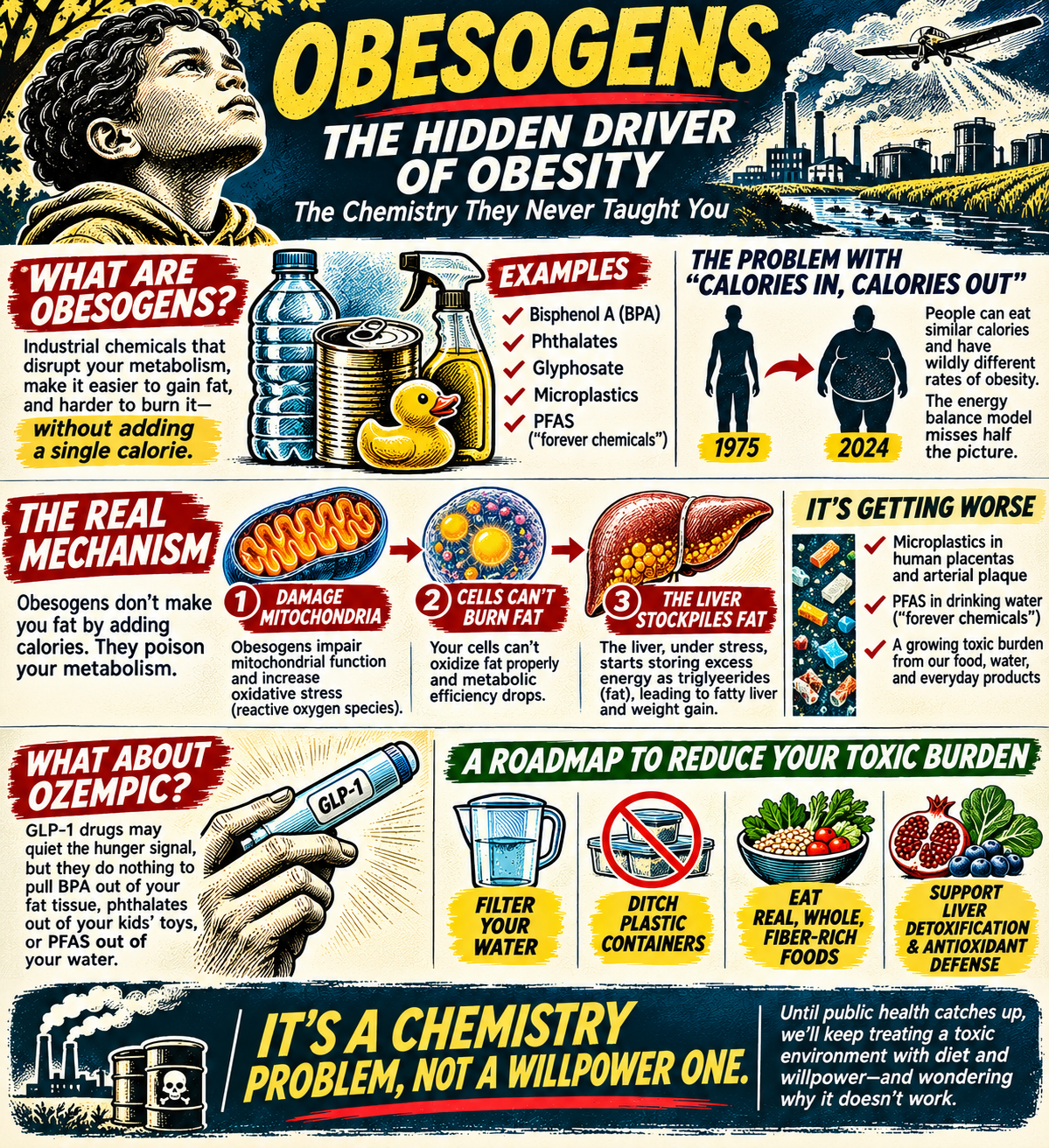
I sat down with Dom D’Agostino back in 2024 to talk about something that should terrify you more than the calorie counter on your treadmill: obesogens. Bisphenol A. Phthalates. Glyphosate. Chemicals you never voted for, sprayed on your food, leaching from the can lining your soup, sitting in your bloodstream doing something your endocrinologist was never trained to look for.
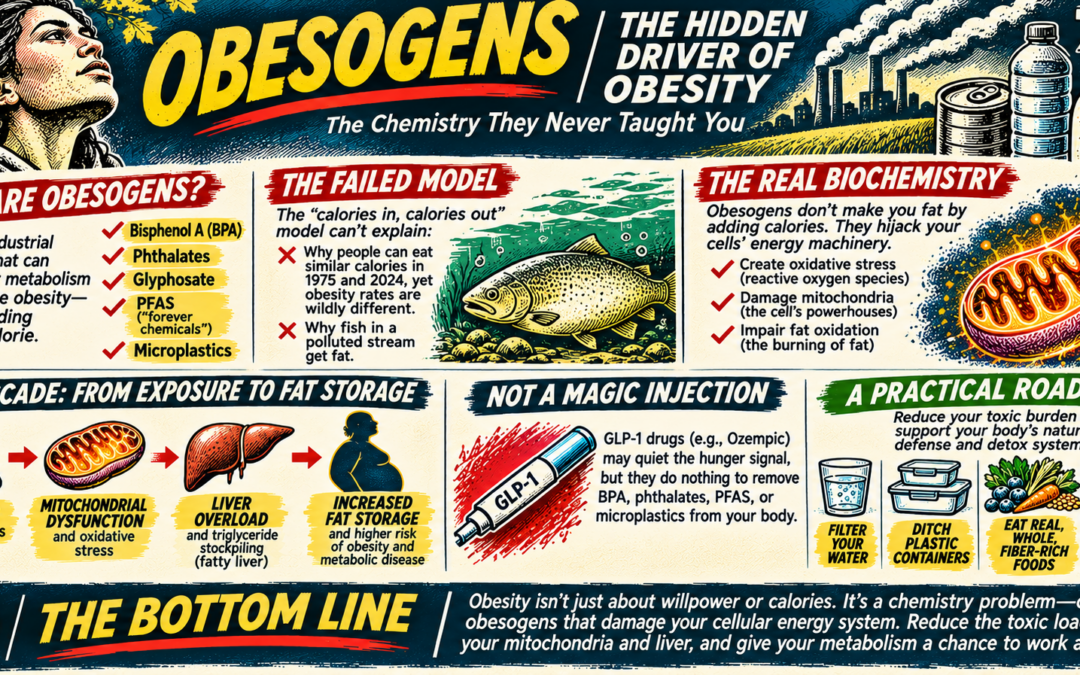
Here’s the central problem with the energy balance model (“calories in, calories out”) that’s been strangling obesity science for fifty years: it can’t explain why a population can eat the same number of calories in 1975 and 2024 and have wildly different rates of obesity. It can’t explain why fish in a polluted stream get fat. It misses half the picture. What doesn’t miss the picture is redox biology. Reactive oxygen species. Mitochondrial dysfunction. These obesogens don’t make you fat by adding calories — they make you fat by poisoning the machinery that’s supposed to burn the calories you already have. Your mitochondria choke, your cells can’t oxidize fat properly, and the liver, panicking and doing its best, starts stockpiling triglycerides. That’s a biochemistry problem, manufactured by an industrial chemical supply chain that has never once been asked to prove its products are metabolically safe.
Tie that to today, and nothing has gotten better. Arguably it’s gotten worse. Microplastics are now showing up in human placentas and arterial plaque. PFAS, the so-called “forever chemicals”, are in your drinking water whether your city admits it or not. Meanwhile the entire cultural conversation about obesity has been hijacked by Ozempic and its cousins, as if the answer to a toxic food and chemical environment is simply to suppress everyone’s appetite with a weekly injection. GLP-1 drugs may quiet the hunger signal, but they do nothing to pull bisphenol A out of your fat tissue or phthalates out of your kids’ toys.
The unifying theory Dom and I discussed is a roadmap of sorts. If obesogens damage mitochondrial function and drive oxidative stress, then the fix is reducing your toxic burden… filtering your water, ditching the plastic containers, eating foods (real, whole, fiber-intact foods) that support liver detoxification and antioxidant defense. Until the public health conversation catches up, we’ll keep treating a chemistry problem with a willpower solution and wondering why it doesn’t work.
Here’s our whole conversation, via an episode of “The Metabolic Link” podcast: Dr. Robert Lustig | Obesogens:… – The Metabolic Link – Apple Podcasts
Same Old Tricks
Want to stop letting Silicon Valley control our lives? Refuse to buy the latest iPhone
The Same Trick, Again
Four years ago, I wrote a piece arguing that if you wanted to stop letting Silicon Valley run your life, the place to start was refusing to buy the new iPhone. The hardware wasn’t bad; the hardware is never the problem. The issue was that the entire industry runs on a single, devastating premise: that your actual life, the one you’re living right now unmediated, is not good enough. That you need an escape hatch in your pocket, and that Silicon Valley, out of the goodness of its shareholders’ hearts, has built you one. Here are my original thoughts, via Quartz: Want to stop letting Silicon Valley control our lives? Refuse to buy the new iPhones
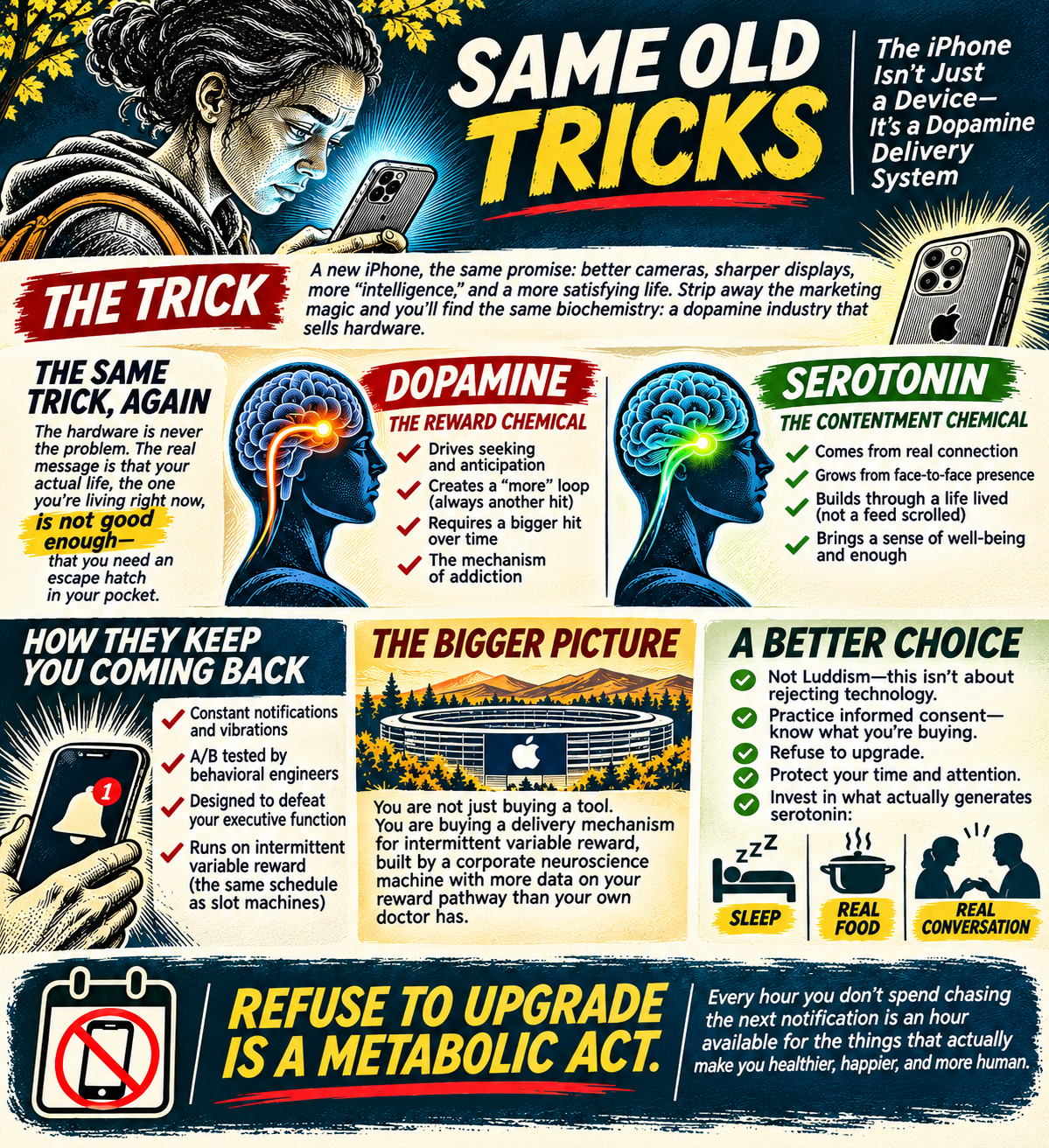
There is always a new iPhone. And the pitch is, once again, dressed up in the language of wonder: better cameras, sharper displays, some new “intelligence” behind the glass. Strip away the marketing magic and you’ll find the same biochemistry I’ve been describing for years. It’s a dopamine industry that happens to sell hardware.
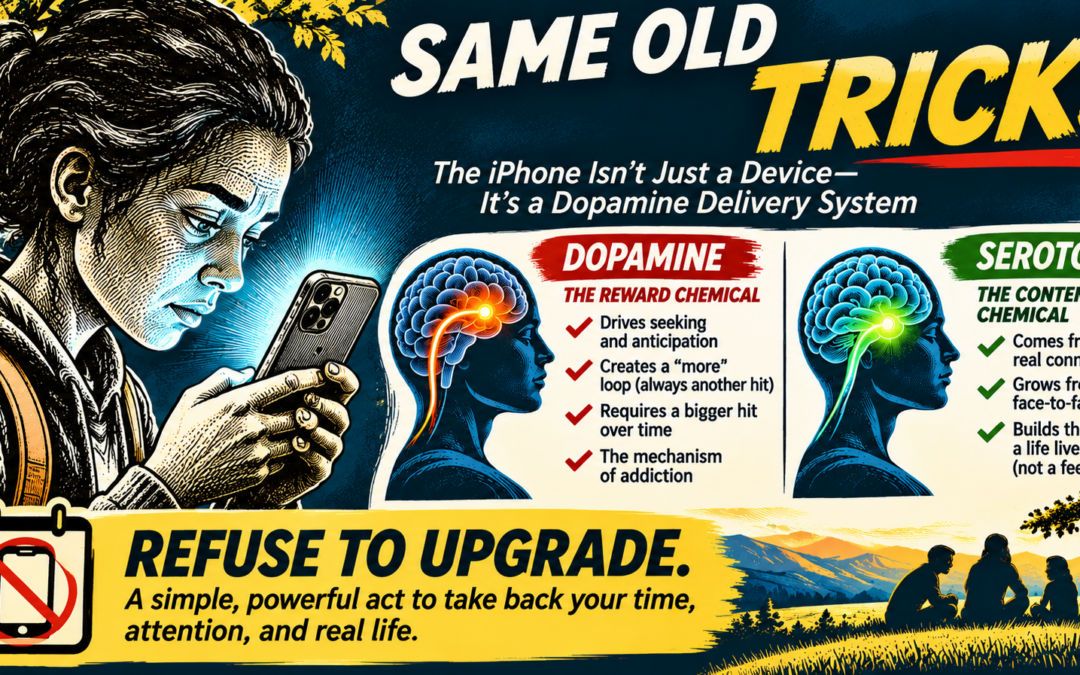
Here’s what nobody in Cupertino will tell you at a product launch: dopamine is not the pleasure chemical. It’s the reward chemical, and reward is not the same thing as contentment. Dopamine is the molecule of more… it fires in anticipation and it drives seeking. Every hit requires a slightly bigger one next time to produce the same effect. That is the mechanism of addiction, whether we’re talking about sugar, alcohol, or a screen that buzzes in your pocket. The device doesn’t need to make you happy. It only needs to make you come back. Those are different goals, and only one of them is profitable at scale.
What galled me when I wrote that piece (and what galls me about this launch) is the underlying assumption that boredom is a problem to be engineered away, that a quiet, unstimulated moment is a bug rather than the precondition for an actual human life. Serotonin, the contentment chemical, comes from connection, from face-to-face presence, from the slow accumulation of a life lived rather than a feed scrolled. You cannot get serotonin through a screen. You can only get dopamine.
Nobody’s forcing you to buy it. True, in the same sense that nobody forces a kid to eat the candy placed at his eye level in the checkout line. Every subtle vibration is A/B tested by teams of behavioral engineers whose job is to defeat your executive function. You are competing with a corporation’s neuroscience department, and they have more data on your reward pathway than your own doctor does.
So what do I actually recommend? Not Luddism; I’m not asking anyone to go live in a cabin. I’m asking for the same thing I ask of anyone facing down a substance built to be habit-forming: informed consent. Know what you’re buying. You are not buying a tool, primarily. You are buying a delivery mechanism for intermittent variable reward, the single most addictive reinforcement schedule known to behavioral science (it’s the same schedule that runs slot machines). Apple didn’t invent it, they just put it in your pocket and charged you a thousand dollars for the privilege.
Refusing to upgrade is a metabolic act. Every hour you don’t spend chasing the next notification is an hour available for the things that actually generate serotonin: sleep, food you cooked yourself, a conversation with someone in the same room as you. The new iPhone will sell millions of units this week regardless of what I write here. That was never really the point. The point is that you get to notice that the hunger it’s promising to satisfy was manufactured in the first place.
Food Junkies
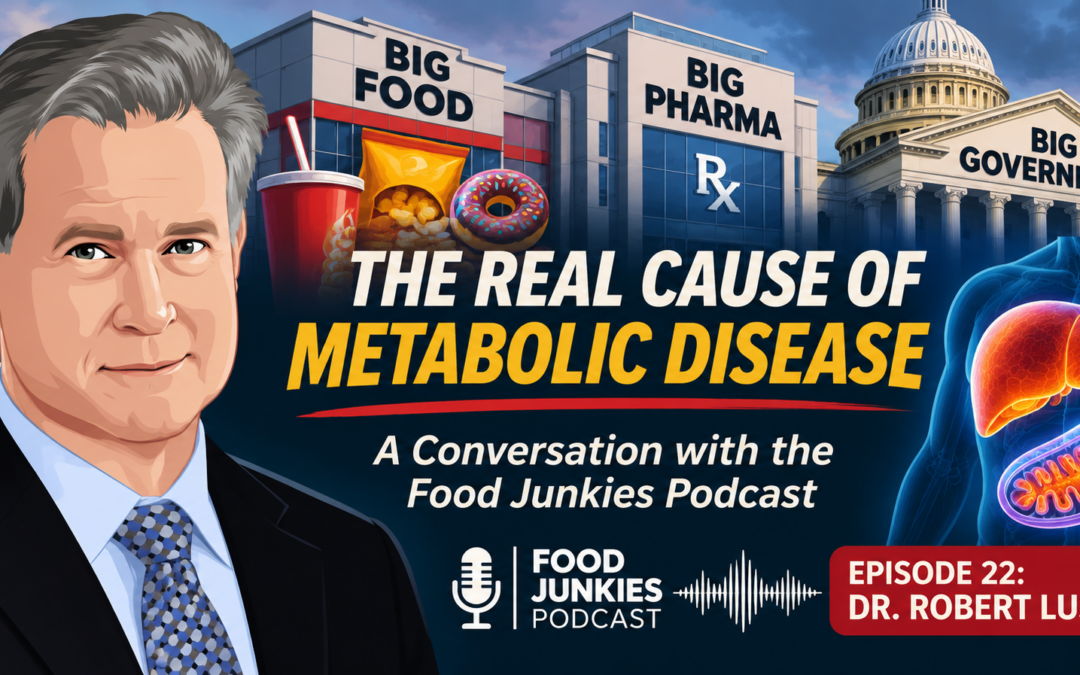
When I sat down with the Food Junkies Podcast in May 2021 to discuss my book Metabolical, I had my gloves off for Big Food and Big Medicine. When I recently went back and listened to the episode again, what struck me most was how little has changed.
Here’s why I still think it’s worth your minutes:
Most nutrition advice starts in the wrong place. It starts with the scale. It starts with willpower. And it treats a calorie from a soda and a calorie from an almond as interchangeable units of the same currency.
They are not. Your liver knows the difference. Your mitochondria know the difference.
And you didn’t choose the food environment that surrounds you. The food industry did (because highly processed foods are profitable).
I’ve spent more than a few decades studying and treating metabolic disease. I saw children developing metabolic dysfunction long before many people were willing to have an honest conversation about sugar.
In this conversation, we moved across nutrition, food science, metabolism, and global health. But ultimately, the message is straightforward: if we want to address chronic disease, we have to address its underlying causes rather than simply treating its downstream consequences. That means looking beyond the individual and examining the systems that shape what we eat, including the incentives operating across Big Food, Big Pharma, and Big Government.
You can follow the conventional advice and still develop fatty liver, insulin resistance, or other manifestations of metabolic disease. Some years have passed, but we still have on our hands an environment that makes metabolic dysfunction easier to develop and harder to escape.
Go listen: Episode 22: Dr. Robert Lustig — Food Junkies Podcast
New Food Guidelines
In this episode of New Frontiers in Functional Medicine, Dr. Kara Fitzgerald talks with Dr. Robert Lustig, pediatric neuroendocrinologist and leading critic of added sugar and ultra-processed foods (UPFs), recorded right after the release of the new USDA dietary guidelines.
It’s not about obesity. It’s about metabolic health.
We keep treating chronic disease as if it were primarily a problem of individual behavior: eat less, exercise more, lose weight.
But what if we’ve been asking the wrong question?
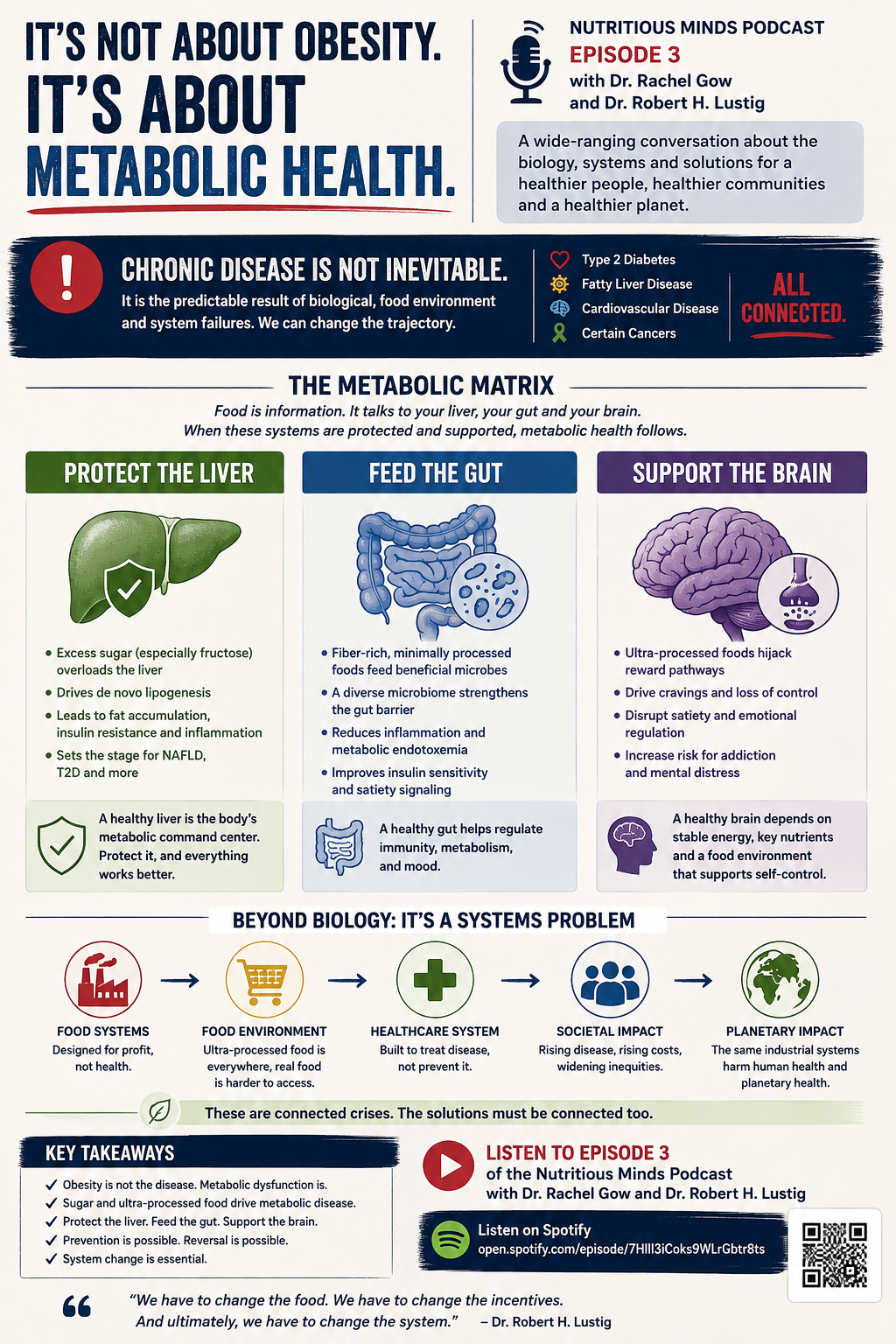
In an episode of the Nutritious Minds Podcast, Dr. Rachel Gow sits down with Dr. Robert H. Lustig for a wide-ranging conversation about what is actually driving the epidemic of chronic metabolic disease—and why solving it requires looking beyond calories, weight, and personal responsibility.
Recorded while Dr. Lustig was in London speaking at the IPM Congress, the conversation begins with the biology.
What happens to the liver? What happens to the gut? What happens to the brain?
Sugar and ultra-processed food don’t simply provide calories. They can alter metabolic function, disrupt satiety and reward pathways, promote insulin resistance, and contribute to the cascade of chronic diseases now consuming an ever-larger share of healthcare resources worldwide.
That distinction matters because obesity is not the disease. Metabolic dysfunction is the disease.
You can be thin and metabolically unhealthy. You can carry excess weight and remain metabolically healthy. If we continue using the bathroom scale as our primary measure of health, we will continue missing what is happening underneath it.
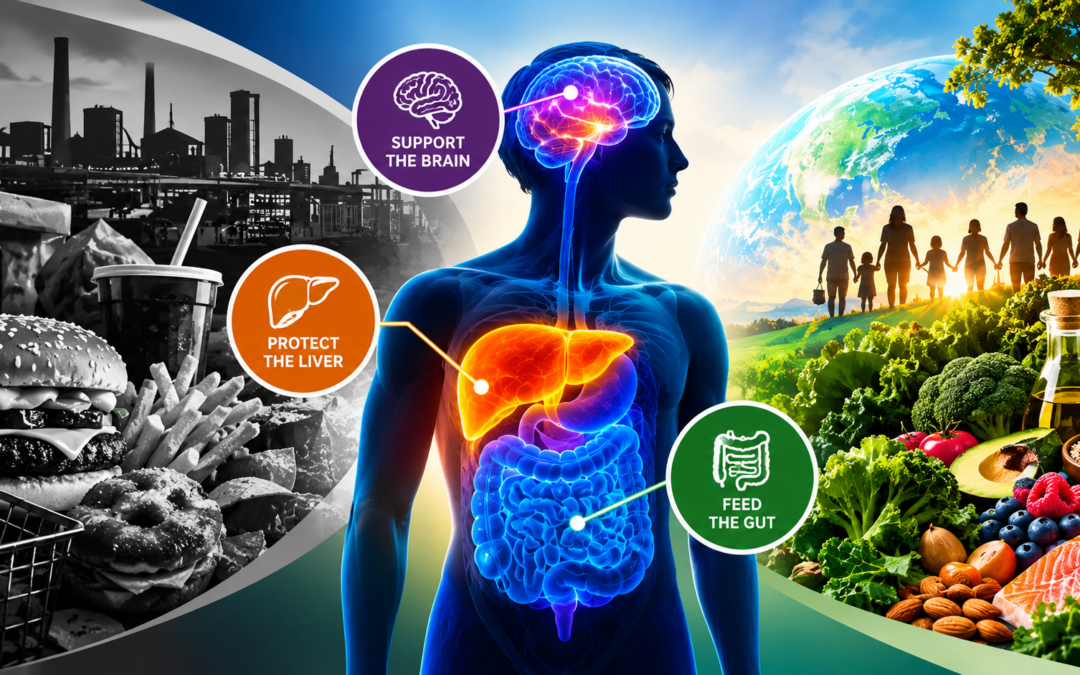
The conversation also returns to the Metabolic Matrix, developed through the work of Dr. Lustig, Dr. Rachel Gow and colleagues, and its three deceptively simple principles:
Protect the liver. Feed the gut. Support the brain.
These principles offer a different way of thinking about food—not simply in terms of calories, nutrients, or marketing claims, but in terms of what food actually does once it enters the human body.
And that leads to the bigger question.
If our food environment is helping drive metabolic disease, if our healthcare systems are largely designed to manage disease after it develops, and if the same industrial systems affecting human health are also placing enormous pressure on planetary health, then these are not separate problems.
They are connected.
The good news is that chronic metabolic disease is not necessarily destiny. Much of it is preventable. Some of it is reversible. But prevention requires more than telling people to make better choices inside an environment engineered to make those choices difficult.
We have to change the food.
We have to change the incentives.
And ultimately, we have to change the system.
This conversation is about how we begin.
Listen to Episode 3 of the Nutritious Minds Podcast with Dr. Rachel Gow and Dr. Robert Lustig.
Diary of a CEO with Dr. Lustig (1st Episode)
Diary of a CEO with Dr. Lustig (2nd Episode)

Two Reports on Sugar from Leading Financial Institutions
Two leading financial institutions have produced reports on sugar, indicating the market for sugar is at a crossroads:
Rabobank
Article – Sugar Consumption: Examining the Bend in the Trend

Obesogens: a unifying theory for the global rise in obesity
- Obesity is biochemistry.
- The behavior is a result of the biochemistry.
- Bad diets cause obesity through REDOX generation.
- Prevention is the only solution.

Unhack your mind and your purchasing
UNHACK YOUR FOOD AND BEVERAGE PURCHASING
Did you know there is a “science” to hacking your mind and your purchasing behavior? It is called “neuromarketing,” and it is being deployed by an army of marketing specialists who have made it their business to manipulate your decisions regarding purchases of foods and beverages.
When “Hacking of the American Mind” was published in 2017, I pointed out that in the last forty years, government legislation and subsidies have promoted ever-available temptation (sugar, drugs, social media, porn) combined with constant stress (work, home, money, Internet), with the end result of an unprecedented epidemic of addiction, anxiety, depression, and chronic disease. And with the advent of neuromarketing, corporate America has successfully imprisoned us in an endless loop of desire and consumption from which there is no obvious escape.
But now there is an obvious escape, at least from harmful foods and beverages.
Simply filter them out effortlessly, using cutting-edge new technology that works in the opposite way that neuromarketing does.
I have worked with an innovative new startup called Perfact to develop paradigm-shifting tools that empower you and your knowledge about foods and beverages to make rational, informed decisions based on science-based criteria easily and quickly.
My new “no added sugar” solution filters out 74% of packaged goods in the food supply that contain added sugar. With 262 forms of added sugar currently in the food supply, reducing sugar consumption by simply reading the labels would be an impossible task.
I also provide a “safe added sugar filter” that allows just enough sugar to stay within guidelines established by leading health authorities. Once you eliminate products with added sugar, you might also want to consider what types of sweeteners are used, so I provide several filters for these ingredients as well.
I’m asking everyone in our movement to try out the FREE Perfact solutions and to help provide feedback on the experience. It is a new technology, supporting consumers in a fundamentally new way, so please become part of this important movement to unhack your shopping experience, transform the way you shop, and change the food system for the better.
Simply click here and visit my website to learn more and try out the Perfact filters for FREE and with no cumbersome sign-up required!