
Want to stop letting Silicon Valley control our lives? Refuse to buy the latest iPhone
The Same Trick, Again
Four years ago, I wrote a piece arguing that if you wanted to stop letting Silicon Valley run your life, the place to start was refusing to buy the new iPhone. The hardware wasn’t bad; the hardware is never the problem. The issue was that the entire industry runs on a single, devastating premise: that your actual life, the one you’re living right now unmediated, is not good enough. That you need an escape hatch in your pocket, and that Silicon Valley, out of the goodness of its shareholders’ hearts, has built you one. Here are my original thoughts, via Quartz: Want to stop letting Silicon Valley control our lives? Refuse to buy the new iPhones
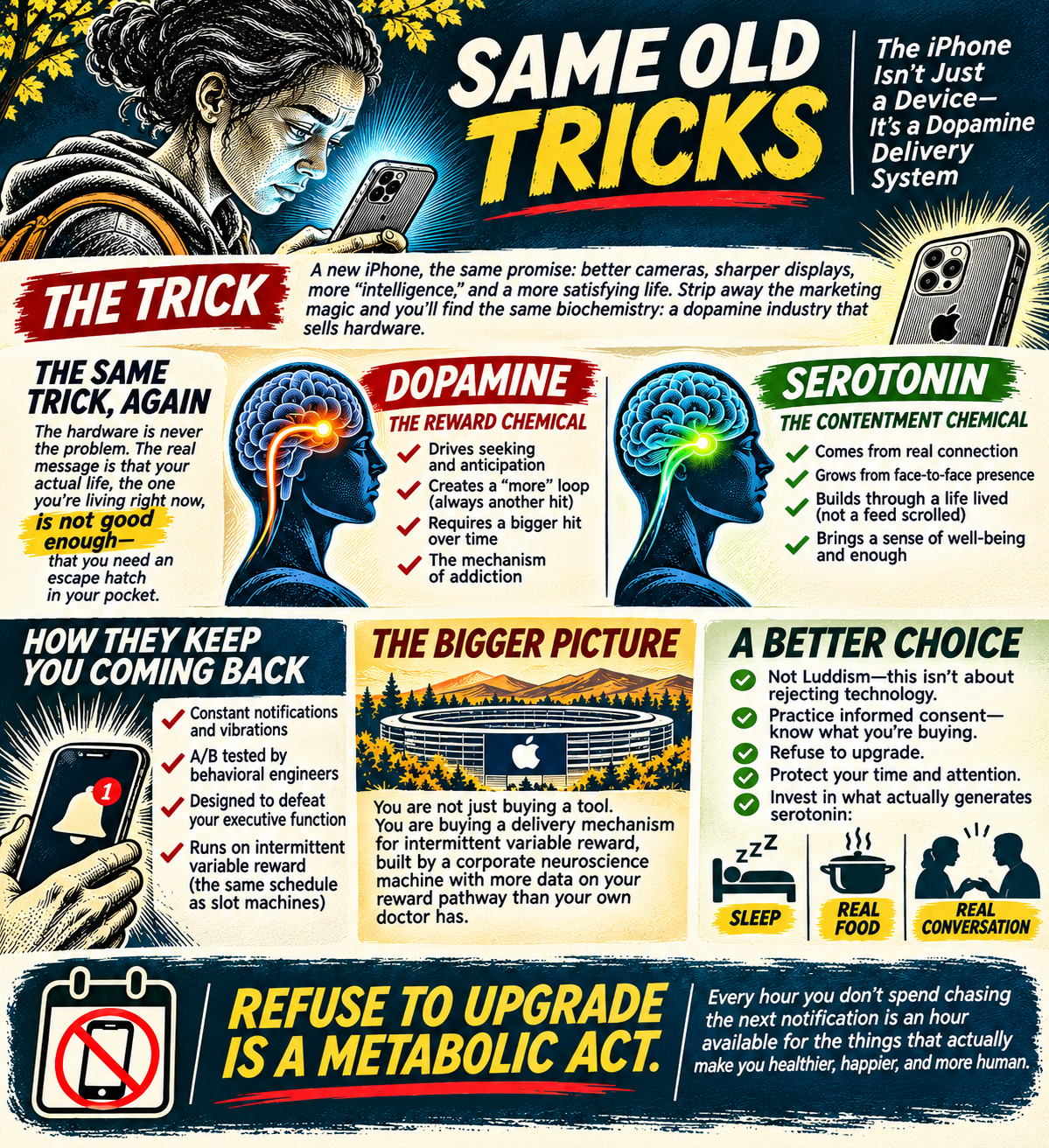
There is always a new iPhone. And the pitch is, once again, dressed up in the language of wonder: better cameras, sharper displays, some new “intelligence” behind the glass. Strip away the marketing magic and you’ll find the same biochemistry I’ve been describing for years. It’s a dopamine industry that happens to sell hardware.
Here’s what nobody in Cupertino will tell you at a product launch: dopamine is not the pleasure chemical. It’s the reward chemical, and reward is not the same thing as contentment. Dopamine is the molecule of more… it fires in anticipation and it drives seeking. Every hit requires a slightly bigger one next time to produce the same effect. That is the mechanism of addiction, whether we’re talking about sugar, alcohol, or a screen that buzzes in your pocket. The device doesn’t need to make you happy. It only needs to make you come back. Those are different goals, and only one of them is profitable at scale.
What galled me when I wrote that piece (and what galls me about this launch) is the underlying assumption that boredom is a problem to be engineered away, that a quiet, unstimulated moment is a bug rather than the precondition for an actual human life. Serotonin, the contentment chemical, comes from connection, from face-to-face presence, from the slow accumulation of a life lived rather than a feed scrolled. You cannot get serotonin through a screen. You can only get dopamine.
Nobody’s forcing you to buy it. True, in the same sense that nobody forces a kid to eat the candy placed at his eye level in the checkout line. Every subtle vibration is A/B tested by teams of behavioral engineers whose job is to defeat your executive function. You are competing with a corporation’s neuroscience department, and they have more data on your reward pathway than your own doctor does.
So what do I actually recommend? Not Luddism; I’m not asking anyone to go live in a cabin. I’m asking for the same thing I ask of anyone facing down a substance built to be habit-forming: informed consent. Know what you’re buying. You are not buying a tool, primarily. You are buying a delivery mechanism for intermittent variable reward, the single most addictive reinforcement schedule known to behavioral science (it’s the same schedule that runs slot machines). Apple didn’t invent it, they just put it in your pocket and charged you a thousand dollars for the privilege.
Refusing to upgrade is a metabolic act. Every hour you don’t spend chasing the next notification is an hour available for the things that actually generate serotonin: sleep, food you cooked yourself, a conversation with someone in the same room as you. The new iPhone will sell millions of units this week regardless of what I write here. That was never really the point. The point is that you get to notice that the hunger it’s promising to satisfy was manufactured in the first place.

Recent Comments