U.S. obesity as delayed effect of excess sugar
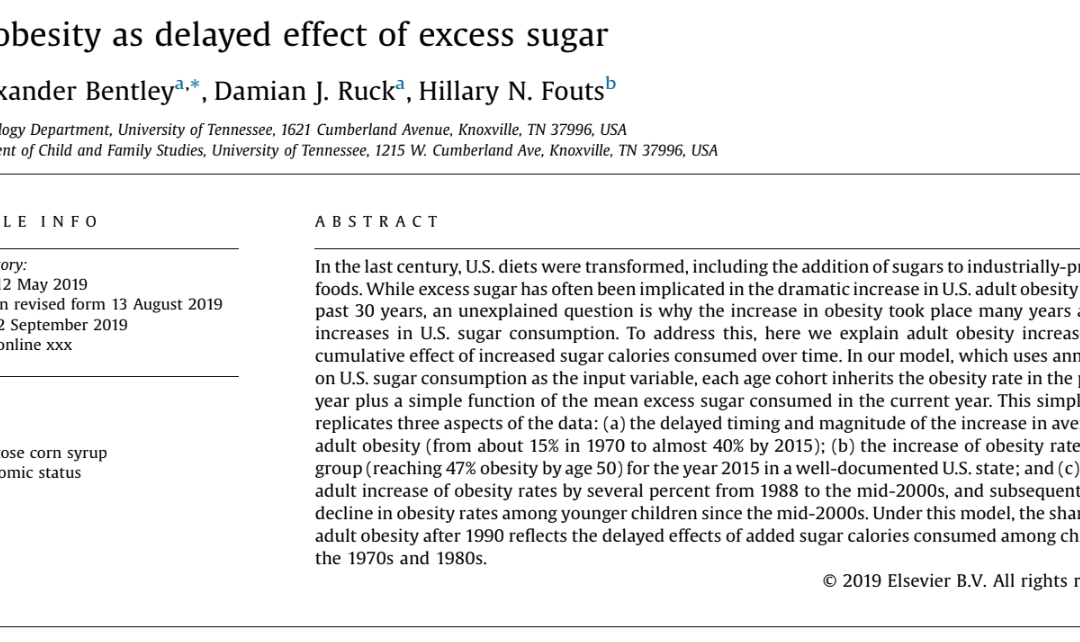
This paper is huge. One of the arguments the food industry advances is that sugar consumption has gone down while obesity has gone up, so it can’t be sugar. This paper uses a complex statistical analysis to show that US obesity is a function of both current sugar consumption and an derivative of the sugar consumed by the previous generation going forward. In other words, it’s the economic equivalent of “epigenetics”. This is yet another nail in the coffin (as if we needed any more nails)!
U.S. obesity as delayed effect of excess sugar
https://www.sciencedirect.com/science/article/pii/S1570677X19301364
Synthetic or non-nutritive sweeteners
“The majority of observational studies addressing synthetic or non-nutritive sweeteners (NNS) consumption show an association with metabolic dysregulation.”
Beyond food intake, numerous studies have shown…
animals consuming synthetic sweeteners exhibit weight gain
Feijó et al., 2013
Swithers and Davidson, 2008
Swithers et al., 2010
Swithers et al., 2013
impaired glucose homeostasis
Suez et al., 2014
Swithers et al., 2012
weaker caloric compensation
Swithers et al., 2010
synthetic sweeteners act through the microbiome
Suez et al., 2014
reduced validity of “sweetness” to predict caloric content
Swithers et al., 2010
significant correlation between NNS consumption and weight gain in an 80,000 participants study
Stellman and Garfinkel, 1988
Other independent studies confirmed these associations, with synthetically sweetened beverage consumption being associated with a much higher incidence of metabolic syndrome (odds ratio ∼1.93) when compared to non-users
Fowler et al., 2008
Lutsey et al., 2008
and NNS consumption has been identified as a significant risk factor for metabolic disease
in children
Blum et al., 2005
in middle-aged adults
Dhingra et al., 2007
and in the elderly
Fowler et al., 2015
One study showed that NNS consumers exhibit reduced weight gain
Schulze et al., 2004
however, these participants showed increased risk for developing diabetes in an 8-year follow-up.
Furthermore, human intervention studies have also shown that ingestion of NNS could
enhance appetite
Blundell and Hill, 1986
Rogers and Blundell, 1989
promote hunger
Tordoff and Alleva, 1990
and increase food consumption
Lavin et al., 1997
Rogers and Blundell, 1989
Tordoff and Friedman, 1989a
resulting in impaired glucose tolerance
Pepino et al., 2013
Suez et al., 2014
However, other studies have reported no major effect or weight loss as a result of consuming NNSs
De La Hunty et al., 2006
de Ruyter et al., 2012
Raben et al., 200
The overall impact of NNS on metabolic health remains controversial.
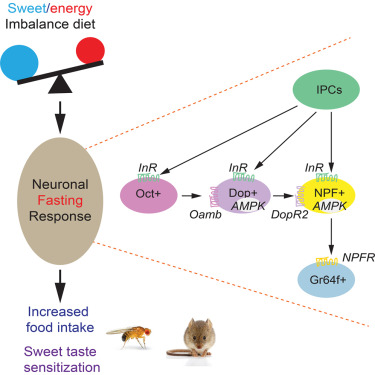
“Despite inclusion in thousands of products, and consumption by billions of people, the molecular effects of ingesting synthetically sweetened food are not well understood. Moreover, there is conflicting evidence from both human and animal studies as to whether or not synthetic sweeteners interact with overall physiology or regulation of energy homeostasis.”
Excerpts from: Sucralose Promotes Food Intake through NPY and a Neuronal Fasting Response
All the studies referenced here are cited and hyperlinked in the article.

Endocrine Society Announces New Clinical Practice Guideline To Identify People At Metabolic Risk
Finally, they’ve woken up and smelled the coffee! Obesity is not the issue, metabolic health is.
But there are three other markers that are important: fasting insulin, uric acid, and ALT.
-Dr. Robert Lustig
Endocrine Daily Briefing – From the Endocrine Society
Endocrine Society Issues New Clinical Practice Guideline To Identify People At Metabolic Risk
Medscape (7/31, Busko, Subscription Publication) reports, “By screening for five simple markers – waist size, blood pressure, HDL cholesterol, triglycerides, and glucose/HbA1C – during office visits, clinicians could identify high-risk adults who need to improve their lifestyle to prevent cardiovascular disease or type 2 diabetes [T2D],” experts recommend in a “new clinical practice guideline – ‘Primary Prevention of ASCVD and T2DM in Patients at Metabolic Risk’ – issued by the Endocrine Society and published online July 31 in the Journal of Clinical Endocrinology and Metabolism.” Included in the new guideline is “the American Heart Association/American College of Cardiology Pooled Cohort Equation to calculate 10-year risk for atherosclerotic disease.”
Endocrine Today (7/31, Schaffer) reports the guideline states, “The Endocrine Society has recognized the importance of identifying individuals who are at metabolic risk so that efforts can be instituted to prevent both [atherosclerotic] CVD and [type 2 diabetes].” In particular, the guideline “addresses individuals with components of metabolic syndrome who do not yet have diagnosed atherosclerotic CVD or type 2 diabetes and the steps that can be taken to prevent these two diseases.” In addition, it “focuses on behavioral, nutritional and medical management.”
According to Endocrine News (7/31, Seaborg), “the original Endocrine Society guideline on this topic was published in 2008.” This revision, however, “takes a fresh look at metabolic risk and presents recommendations which reflect more recent trial data on blood pressure and lipids,” prioritizing “lifestyle and behavioral interventions” while discussing “new medical treatment options.” Even though “the guideline is targeted towards adults aged 40 to 75,” it “can be used to guide patients outside of this age range as well.”
Also covering the story are the Endocrinology Advisor (7/31, Beairsto) and Clinical Endocrinology News (7/31, Splete).
Read more:
The Juice PR Machine
How scared is the juice industry? Nothing wrong with their making a critique, just remarkable to see what lengths they will go to squelch dissent.
From the resistance… a letter received from the Juice Products Association:
It’s a trend we are all seeing – more and more studies are being conducted and published without pre-specified analysis. Researchers test connections unsystematically and publish only positive results. Our standards for how we conduct and communicate nutrition research to the public are slipping.
Last week a study was published, by the British Medical Journal that suggests that drinking 100% juice is linked with an increased risk of cancer. As you know, a person’s health is dependent upon the totality of their diet and lifestyle – not one specific food or beverage. Studies such as this one do not prove cause and effect yet that is what headlines scream.
Furthermore, these results contradict several other studies, including large U.S. cohort studies, concerning 100% fruit juice consumption and cancer, which shows no association with increased risk. In fact, 100% fruit juices contain bioactive compounds that have been shown to have anti-carcinogenic properties in some studies, (Veselkov et al. Scientific Reports. 2019;9:9237).
There were a number of limitations with the NutriNet-Santé study published last week. These include, but are not limited to:
- The study is observational and, as such, is unable to show cause and effect, only associations.
- The study was based on a French cohort and not representative of US culture, dietary patterns and eating styles. It is also not indicative of typical consumption patterns seen in the United States regarding sugary drink consumption.
- Much of the data was obtained through self-reporting, which introduces errors
- The mean follow-up time (about 5 years) is very short for a cancer study
- These results cannot be applied to a general population as the cohort was overwhelmingly female (almost 79%)
Together, we can make our voices heard against bad science. I am commenting on news coverage regarding this study in order to educate the public and consumers who are confused about nutrition. I urge you to join me in speaking out against studies like this that are not based on scientific best practices and cause unnecessary consumer confusion.
For more information, visit SipSmarter.org. Please don’t hesitate to contact me directly if you have any questions, concerns, or need any other information. I would be happy to discuss.
Sincerely,
Diane Welland MS, RD
Juice Products Association
What about fruit juice?
Fruit Juices Are Basically Just Liquid Sugar
Fruit juice products are exploding and it seems like most people believe fruit juices are healthy…they come from fruit, so they must be OK?
Unfortunately, many of the “fruit” juice products you find in the supermarket aren’t even fruit juice, just fruit flavored beverages imbued with chemicals that taste like fruit. Many of these products are basically fruit-flavored sugar water.
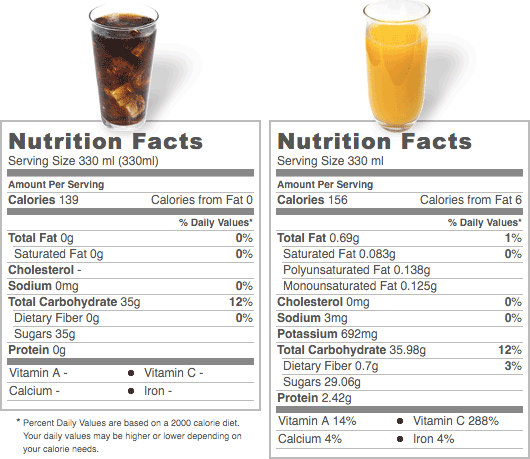
Even if you’re drinking 100% fruit juice (organic, natural, made in your own juicer, blah, blah, blah), it is still a problem. Fruit juice often has had the fiber taken out or destroyed and the main thing left is the sugar, now concentrated. Despite their healthy image and brilliant marketing, many fruit juice products contain the same amount of sugar as sugar-sweetened beverages.
A typical glass of orange juice contains 4 oranges. One serving of orange juice (an 8-ounce glass) contains 22 grams of sugar. By comparison, 8-ounces of Dr. Pepper (pick your soda) contains 27 grams of sugar.
One simple solution is not to drink your calories. Eat whole fruit – with the fiber. Try “spa water” recipes that use small amounts of fruit for flavoring. And when you absolutely need some juice, than make it a small glass.
How many oranges have you consumed in one sitting? The fiber in whole fruit increases satiety and also helps to metabolize the sugar in healthy ways. Since our diet is already so overloaded with sugar, big blasts of sugar tend to be bad for our metabolic health.

Recent Comments