Tobacco Industry Involvement in Children’s Sugary Drinks Market: Cigarette Giants Bought Food Companies, Used Cartoon Characters, Colors, Flavors to Boost Sales of Sweetened Beverages, UCSF Study Shows
Tobacco conglomerates that used colors, flavors and marketing techniques to entice children as future smokers transferred these same strategies to sweetened beverages when they bought food and drinks companies starting in 1963, according to a study by researchers at UC San Francisco.
The study, which draws from a cache of previously secret documents from the tobacco industry that is part of the UCSF Industry Documents Library tracked the acquisition and subsequent marketing campaigns of sweetened drink brands by two leading tobacco companies: R.J. Reynolds and Philip Morris. It found that as tobacco was facing increased scrutiny from health authorities, its executives transferred the same products and tactics to peddle soft drinks. The study publishes March 14, 2019, in the BMJ.
“Executives in the two largest U.S.-based tobacco companies had developed colors and flavors as additives for cigarettes and used them to build major children’s beverage product lines, including Hawaiian Punch, Kool-Aid, Tang and Capri Sun,” said senior author Laura Schmidt, PhD, MSW, MPH, of the UCSF Philip R. Lee Institute for Health Policy Studies. “Even after the tobacco companies sold these brands to food and beverage corporations, many of the product lines and marketing techniques designed to attract kids are still in use today.”
Fruit Juice, Sports Drinks Linked to Obesity, Metabolic Disease
American youth currently consume an average of 143 calories a day in sugary beverages, according to the Centers for Disease Control and Prevention. These calorie-dense drinks do not provide the satiety of foods and are associated with obesity and metabolic syndrome, a cluster of conditions that increase the risk for heart disease, stroke and Type 2 diabetes.
Sugary beverages include most fruit juices, sports and energy drinks, soda and other beverages sweetened with added sugars, including honey, fructose, glucose, sucrose, dextrose, corn sweetener, malt syrup, corn syrup, brown sugar and raw sugar.
The new papers, which are available in the UCSF Truth Tobacco Industry Documents Library, a subset of the UCSF Industry Documents Library, reveal connections between the tobacco and food industries.
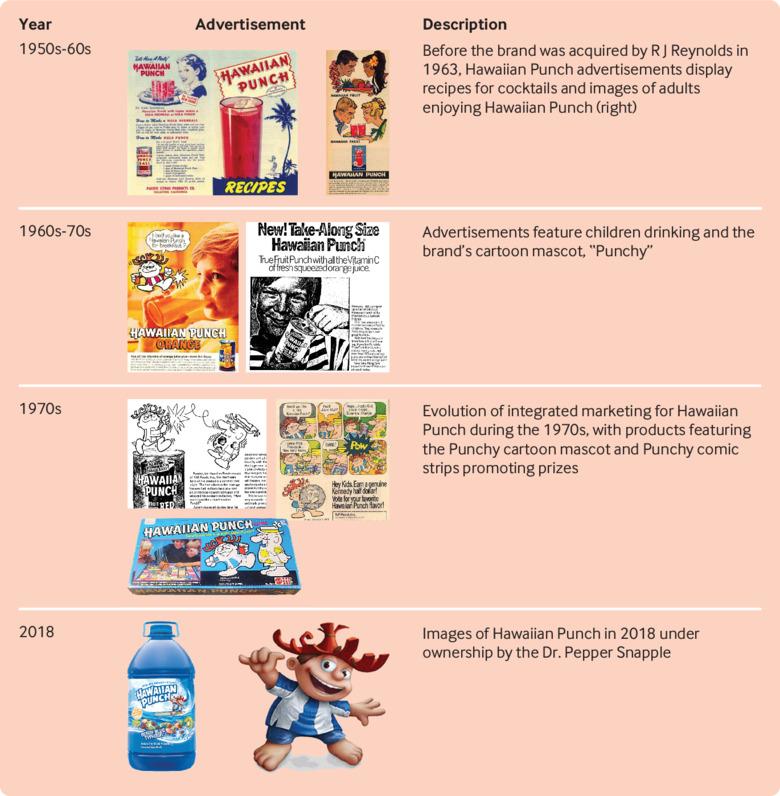
Tobacco giant R.J. Reynolds led the transition to sweetened beverages in 1963 when it purchased Hawaiian Punch from Pacific Hawaiian Products Company, according to the documents. The beverage previously had been promoted to adults as a cocktail mixer, but R.J. Reynolds sought to beef up the drink’s “Punchy” mascot – a counterpart to the “Joe Camel” cartoon character the company used to promote cigarettes – and featured it on toys, schoolbook covers, comics, tumblers, clothing and TV commercials. Punchy became the “best salesman the beverage ever had,” according to tobacco industry documents.
In the ’60s and ’70s, the company conducted taste tests with children and mothers to evaluate sweetness, colors and flavors for Hawaiian Punch product line extensions. The children’s preferences were prioritized, the authors noted.
By 1983, R.J. Reynolds introduced the nation’s first juice box, marketed as a “handy little carton that comes with its very own straw.” This innovation was largely responsible for a 34 percent jump in sales, according to industry documents.
Kool-Aid Joins Marlboro
Meanwhile, tobacco competitor Philip Morris had acquired Kool-Aid, via General Foods, in 1985. The company flipped its marketing audience from families to children, created its “Kool-Aid Man” mascot, and launched collaborations with branded toys, including Barbie and Hot Wheels. It also developed a children’s Kool-Aid loyalty program described as “our version of the Marlboro Country Store,” a cigarette incentives program.
“The Wacky Wild Kool-Aid style campaign had tremendous reach and impact,” said first author Kim Nguyen, ScD, MPH, who is also with the UCSF Philip R. Lee Institute for Health Policy Studies. “Lots of kids in the ’80s dreamed of getting swag from the Wacky Warehouse. What is really ‘wacky’ is that the Kool-Aid kid program was modeled after a tobacco marketing strategy designed to build allegiance with smokers.”
By 2004, Philip Morris had developed at least 36 child-tested flavors to its Kool-Aid line, of which some – like “Great Bluedini” – integrated colors with cartoon characters. The tobacco giant also acquired Capri Sun and Tang, and used similar child-focused integrated marketing strategies to drive those sales.
Most sweetened beverage manufacturers claim to limit marketing to children of unhealthy foods and drinks. The industry launched both the Children’s Advertising Review Unit, to promote responsible advertising to children through industry self-policing, and the Children’s Food and Beverage Advertising Initiative, which states that it devotes 100 percent of “child-directed advertising to better-for-you foods.”
“The industry claims that these tobacco-inspired marketing strategies are not actually targeting children and should be excluded from these industry-led agreements” said Schmidt. “But the evidence cited in our research shows that these product lines and marketing techniques were specifically designed for and tested on children.”
The authors conclude that, given the current high rates of childhood obesity, there is a clear need to replace current industry-led voluntary standards with well-enforced government regulations on marketing sugary beverages to children.
“Parents do play a significant role in what their kids eat and drink,” Nguyen said. “However, we cannot underestimate the influence of these beverage corporations and their marketing. They intentionally develop marketing campaigns that appeal to kids by making the drinks fun and exciting.”
The UCSF Industry Documents Library was launched in 2002 as a digital portal for tobacco documents. Today, the library includes close to 15 million internal tobacco, drug, chemical and food industry documents used by scientists, policymakers, journalists and community members in their efforts to improve and protect the health of the public.
Co-Authors: Stanton Glantz, PhD, from the UCSF Center for Tobacco Control Research and Education; Casey Palmer, MS, RN, from the UCSF Philip R. Lee Institute for Health Policy Studies.
Funding: Laura and John Arnold Foundation, CrossFit Foundation, the National Cancer Institute.
Disclosures: No conflicts of interest.
About UCSF: UC San Francisco (UCSF) is a leading university dedicated to promoting health worldwide through advanced biomedical research, graduate-level education in the life sciences and health professions, and excellence in patient care. It includes top-ranked graduate schools of dentistry, medicine, nursing and pharmacy; a graduate division with nationally renowned programs in basic, biomedical, translational and population sciences; and a preeminent biomedical research enterprise. It also includes UCSF Health, which comprises three top-ranked hospitals – UCSF Medical Center and UCSF Benioff Children’s Hospitals in San Francisco and Oakland – as well as Langley Porter Psychiatric Hospital and Clinics, UCSF Benioff Children’s Physicians and the UCSF Faculty Practice. UCSF Health has affiliations with hospitals and health organizations throughout the Bay Area. UCSF faculty also provide all physician care at the public Zuckerberg San Francisco General Hospital and Trauma Center, and the SF VA Medical Center. The UCSF Fresno Medical Education Program is a major branch of the University of California, San Francisco’s School of Medicine. Please visit www.ucsf.edu/news.
###
For additional information, Contact:
UC San Francisco
Suzanne Leigh
Suzanne.leigh@ucsf.edu
Stories about this research:
How Big Tobacco Hooked Children on Sugary Drinks, New York Times




 The fiber in real food is of two kinds: soluble, which is globular (e.g. beta-glucan, pectin, inulin, etc.); and insoluble, which is stringy (e.g. psyllium, cellulose, chitin, etc.). You need both, as they do different jobs. The insoluble fiber forms a latticework (like a fishing net) in the duodenum, and the soluble fiber plugs the holes in that latticework. Together they form a secondary barrier on the inside of the duodenum, which prevents early absorption of mono- and di-saccharides, as well as other readily absorbable nutrients.
Recent Comments